Corporate video: one story in three minutes, not a tour of departments
What is a corporate video for, and why three minutes and one story? Structure, where real footage is a must, where AI helps, and a checklist for the brief.
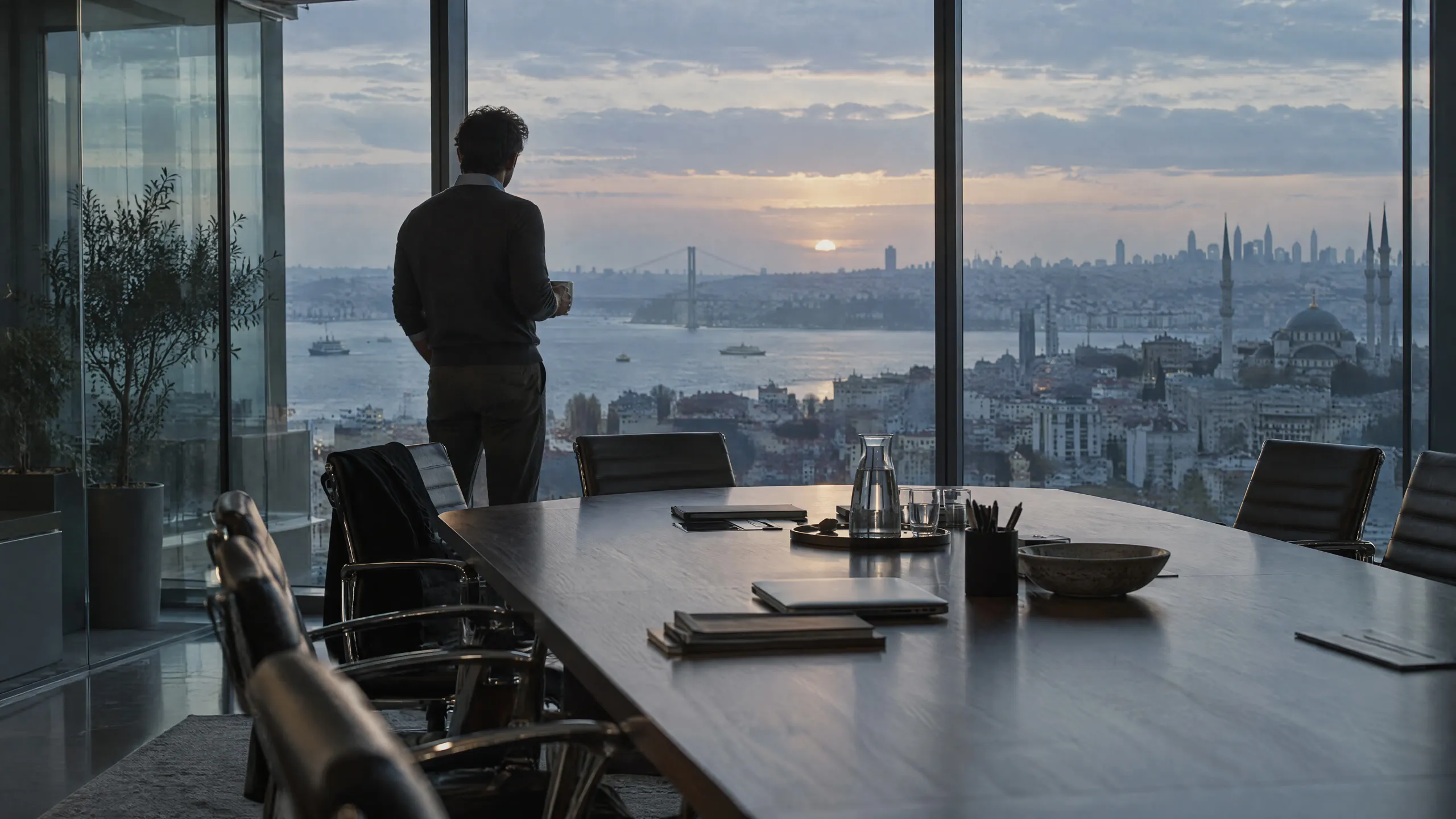
Service Corporate video production ·Watch the sample film
What is a corporate video for?
A corporate video (also called a company video or corporate film) answers one question: what does this company do, and why does it matter? The question stays the same; the person asking changes. So before you write the film, decide who you’re writing it for.
| Who watches | What they look for | The film’s job |
|---|---|---|
| A job candidate | What the place is like and who they’d work with | Show the people and the work itself |
| An investor | The problem, the team and the path to growth | Explain briefly and clearly why the company exists |
| A business customer | Reliability and capacity | Build trust before the sales meeting |
| A trade fair visitor | What you do, in a few seconds | Stop people walking past the stand |
| A website visitor | A short, credible summary | Tell the “About us” page without anyone having to read it |
The same film can be shown to all of them, but one has to be the main audience. A film written for everyone usually says nothing to anyone.
Why three minutes and one story?
The most common trap in corporate films is the list of departments: management first, then production, quality, logistics and sales. Every unit wants to be in the film; viewers remember none of them. A list informs; a story stays with you.
In practice, one story usually takes one of these shapes:
- One customer’s problem. How did it come up, and how did the company solve it?
- One product’s journey. Following a single order from raw material to delivery.
- One day. What a team does from morning to evening.
Three minutes is long enough for that story and short enough to watch before a meeting. Platform guidance points the same way. Google sets no maximum length for skippable video ads on YouTube but recommends staying under three minutes. LinkedIn allows video ads from 3 seconds to 30 minutes, yet recommends 15–30 second videos so an ad qualifies for every placement. In other words, plan a 30-second teaser cut alongside the three-minute master from the start.
Structure: problem, people, proof, promise
A skeleton that works for a three-minute corporate film:
| Part | Approximate timing | What it shows |
|---|---|---|
| Problem | 0:00–0:40 | The unsolved question your customers or your industry face; the company isn’t on screen yet |
| People | 0:40–1:30 | The team that solves it, the work they do and where they do it |
| Proof | 1:30–2:30 | Things that can be verified: production, capacity, certification, a customer reference given with permission |
| Promise | 2:30–3:00 | What the company will do next; a one-sentence close |
The timings are a starting point, not a rule. What matters is the order: viewers first recognise the problem, then meet the people who solve it, see the proof and hear the promise. The logo, the founding year and the message from management get a short place at the close, not at the opening.
Where real footage is a must, and where AI helps
A corporate film has two layers: the company itself and the world it describes. They don’t follow the same rules.
| Needs real footage | Can be built with AI |
|---|---|
| Facilities, factory, offices and labs | Abstract processes: the path of a piece of data, an order moving through a system |
| Employees and managers | The future: the world the company is working towards |
| Products, machines and real capacity | Scale: a network across a country, thousands of deliveries added up |
| Figures, certifications, references | Places you can’t film: inside a turbine, the open sea, a re-enactment of the founding years |
The line is clear: AI makes an idea visible, but it never shows something the company doesn’t have as if it existed. A facility that doesn’t exist, a machine you don’t own or a team that doesn’t work for you has no place in the film. The ICC Advertising and Marketing Communications Code says marketing communications should be truthful and not misleading, whether through text, sound or visuals, and holds marketers who use algorithms or other AI tools responsible for the communications they produce. In Turkey, the Commercial Code treats untrue or misleading statements by a business about itself, its products or its activities as unfair competition.
In practice:
- Re-enactments and future scenes are labelled. A note such as “illustrative re-enactment” doesn’t mislead viewers, and it doesn’t make the film smaller.
- People appear with permission. Every employee who appears in the film gives written consent.
- Figures are documented. Every number in the film rests on a source.
We cover how AI labels appear on each platform in how to tell if a video is AI-generated, and when a traditional shoot is still the right call in how much a commercial costs. This article isn’t legal advice; for films that make claims, talk to your legal counsel.
Corporate films at Cinela
Cinela’s “Corporate story” service is a film that shows what the company does in three minutes. It sits among our enterprise services, alongside annual content plans, agency partnerships and white-label production. There is no fixed price; scope, length and price are set out in a written quote.
The process runs in the same order on every project: brief, script and shot list, a frame for every scene, then music, sound and edit. No step goes ahead without your approval; the details are in our AI commercial production guide. For corporate work, a few points matter in particular:
- Your brief and the files you upload are never used to train any model, and they are deleted at the end of the project.
- You can bring someone from your own team into the film through a photo or video, as long as you hold the rights to it.
- The film is delivered clearly labelled as AI-made, with full usage rights.
- Delivery includes vertical and horizontal masters and a subtitle file; 4K and dubbing are available on request.
A checklist before the brief
- Who is the main audience? Candidates, investors, customers or trade fair visitors.
- What does the company do? Write it in one sentence.
- Which problem do you solve, and for whom?
- What is your proof? Verifiable figures, certifications, references given with permission.
- Which scenes need real footage?
- Has everyone who appears in the film given permission?
- Which cuts do you need? A three-minute master, a 30-second teaser, a silent loop for the trade fair stand, a vertical version.
- In which languages will it be shown? Subtitles or dubbing.
- Where will the re-enactment and AI notes appear?
A one-sentence idea is enough; write to us through the quote form.
Sources
Sources checked in October 2026; see each source for its current text.
- Corporate video
- Corporate communications
- B2B
- AI video
More articles
All articles →-

What is a brand film? How it differs from an ad, its structure and cost
What is a brand film, and how does it differ from a commercial, corporate video or branded content? How a good one is built, where it's used, and cost.
Read -
How to write a commercial script: format, structure and an example
How to write a commercial script: the two-column format, a 30-second structure, an original example script, voice-over rules, common mistakes and a checklist.
Read